Letting Go of What You Can’t Control as a Parent
By Kerry Biskelonis, LPC, RYT
Published 4/17/2026

This article is part of our weekly TGIF newsletter series. To get these in your inbox weekly, sign up below:
Navigating the Growth of Your Children
I have recognized I am in a new season of parenting: both children in elementary, one nearing 9 years old, the older one’s pre-frontal cortex coming online, creating nuance and new frustrations for all of us.
I feel this turning point intimately. I no longer have littles. My youngest now reads himself to sleep after his songs and prayers. I can barely carry the lengthy older one to bed when he falls asleep in my bed, at 9:30 pm, watching Zoo Tampa. They are staying up later, sleeping in, eating so much, and yet always “starving.”
And once again, I have no idea what I’m doing. A new era, once again, no guidebook. Navigating judgments and self-doubt, comparison and competition. Dr. Becky doesn’t have all the answers, nor the child psychiatrist, nor my partner, who also feels the weight of it. My partner and I work hard to remain on the same team, both of us exhausted and perplexed, sometimes laughing together and other times venting. In the best of times, it’s with each other, not at each other.
Because, despite my fruitless attempts over the last decade to protect my kids, trying and failing to optimize their lives, create a “better future” for them, and ward off vulnerability, over and over again, I am reminded that I am not in control. I have never been in control. I cannot be in control.
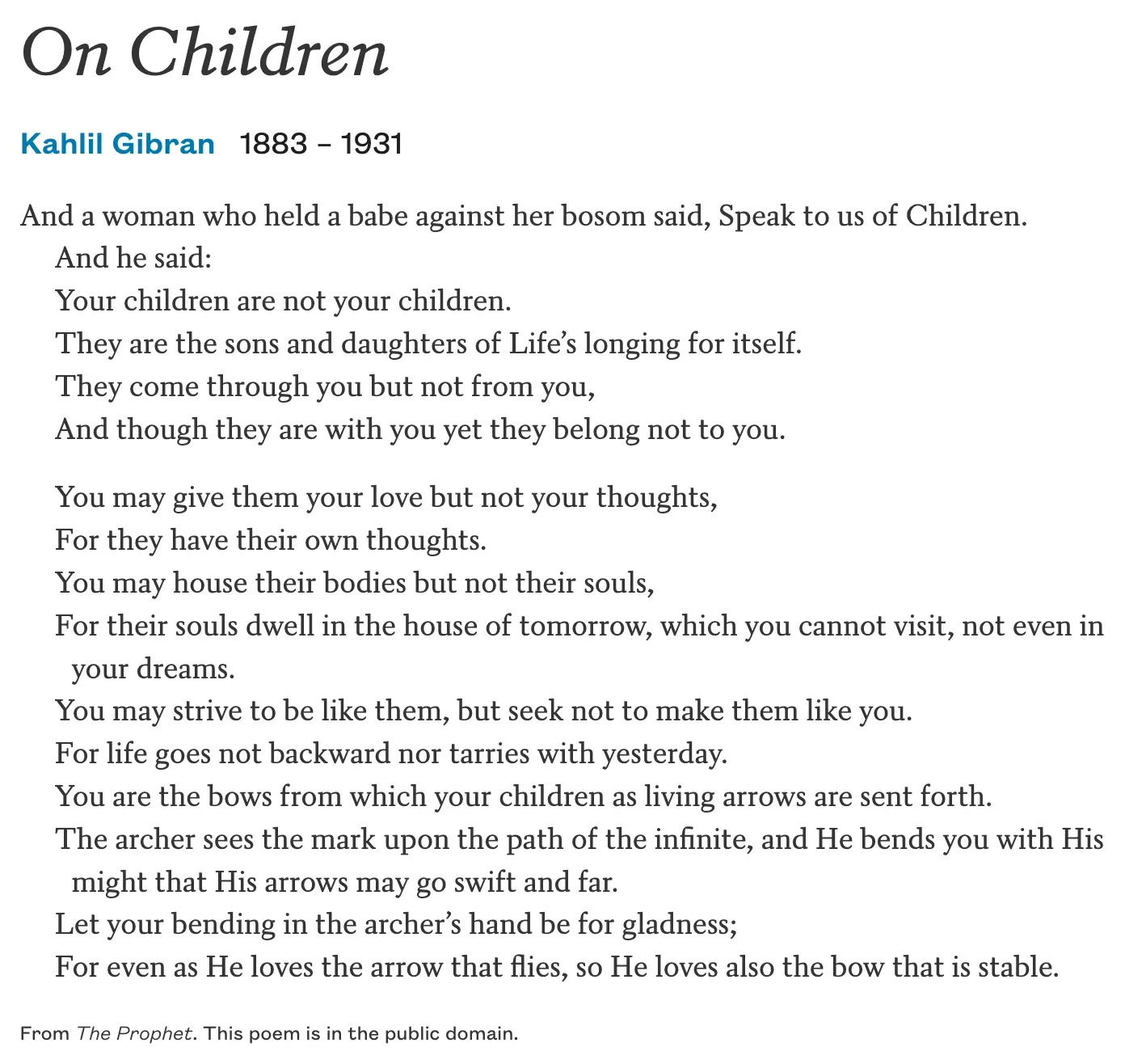
Because these growing creatures are simply life’s longing for itself, as Lebanese poet Kahil Gibran lovingly reminds us.
How a Therapist Finds Meaning and Purpose in Parenthood
This morning, I saw a post about Jonathan Groff’s 2024 Tony Awards acceptance speech. In his emotional list of gratitude, he offers his family: “thank you for always allowing my freak flag to fly without ever feeling weird about it.”
A few years ago, on my birthday, I was meditating on my purpose, asking for direction on what I should do next and what I am supposed to be doing here. Sitting with eyes closed in the backyard, hearing my kids playing in the distance, the answer landed soft and heavy in my heart — your purpose is to allow them to serve their purpose, to let them expand into their gifts.
To me, this was a reckoning that I must continue doing my work so I can offer my children a life where they can grow into their most authentic selves.
I wouldn’t say I’ve ever been a helicopter parent or a snowplow parent, but if there were a Bubble Parent, I could fall into that category. Keep them safe by protecting the variables, the external factors, and influences. Keep them loved and treasured, and their self-esteem bolstered, without letting anything or anyone that could disrupt their authentic expression come into contact with them.
Being a Bumper Parent
As mentioned, I have learned to distrust this illusion. I’m learning how to let go more and more. An analogy was shared with me a few weeks ago, and I’ve taken it on now: I’d like to be a Bumper Parent. You know, the bumpers lining the bowling alley? The thing about bumpers is that while they keep you on the lane, it’s not without bumps, twists, turns, and missing pins. Sometimes it helps you knock the pins down; they keep you from the gutter, but typically just gently nudge you back in line.
And this isn’t an easy mindset to adapt. My older son, with this new area of his brain forming, is trending towards negative bias and a victim mindset. It worries me, pains me, and frustrates me — and I’m sitting with all of that, trying not to let my anxiety write his story for him. My younger son, meanwhile, literally does not GAF. He is completely himself, without fear, like an animated cartoon character constantly skittering along the cliffs of adventure. I love them both for exactly this.
Holding Space for Your Anxiety and Letting It Go
I want to jump into the lane with them, hold their wrist, make sure they keep the ball straight, and gently guide their arm in the right direction. I want to give them all the tips, hire a bowling coach, and be the beaming parent whose kid just got a strike.
I see these parts of myself, I greet them, and with compassion, I ask them to let go. Yes, letting go. Letting go of holding so tightly. Letting go of fear. Letting go of control. Trusting them to let them fail and figure it out.
Keeping the End Goal in Sight
This next stage feels more consequential — more profound in how what I do and how I respond matter. I’m learning that this stage means even stronger boundaries and consistency. It means bigger ruptures and deeper repair. It means steady chores, responsibilities, and consequences. It means discomfort for everyone, holding the tension of not knowing how it’s going to turn out, and loving unconditionally.
It means gently holding the lane — keeping the container steady so that they can flail around, twist and turn, miss the marks — and yet still come back home. A home that accepts them, loves them, and is a place where they belong, first and foremost, to themselves.
A return again and again to letting their freak flags fly — without judgment, control, or questioning.
Where can I find a therapist near me?
At Reset Brain and Body, we support clients through foundational and holistic wellness, nervous system regulation, and more. If this resonates with you, you’re not alone. Our team is here to walk with you—through the overwhelm and into presence.
Ready to begin your healing journey?
Explore our unique approach to foundational wellness or fill out a new client inquiry form.

Conscious Transparency: This newsletter was edited by AI for grammar, spelling, and sentence structure, but every idea, tone of voice, perspective, and word choice was my own. This newsletter is imperfect because a human wrote it. Thank you for your graciousness.
This week’s Tools, Gratitude, Innovation, Feels
Tools: There have been big discussions this week with my friends about the Brick - the tool that sets boundaries with you and your phone. If you haven’t heard of it and find yourself scrolling accidentally, I highly suggest this tool. While I’ve found success enough with the Opal App, Brick takes it to another level. I hate how the attention economy has become a whole thing, built from smartphone addiction, but here is a reasonable answer to the zombie vortex we’ve all found ourselves in.
Gratitude: My younger son is getting an award today at his new school - the Courage Award. He wrote an essay about how brave he felt when he started there, even though he was scared. I’m so proud of him because, for a 5-year-old, moving schools 3/4 of the year through, he has thrived. It’s also his birthday, so I’m so grateful to celebrate him!
Innovation: I often reference Parent Data from Emily Oster with Julie Lythcott-Haims’s book, How to Raise an Adult, when my friends and I are worrying about our kids’ future. Combined, they say, it’s quite simple: for children to be “successful”, they need basic things: food, shelter, and safety, unconditional love, and chores. Add in reading to them, and you’re above average. Relief, right? Well, you choose which one feels hardest ;)
Feels: I am returning to the poem I mentioned earlier - On Children by Kahil Gibran. I believe it’s imperative for all parents, hopeful parents, grandparents, aunts and uncles, and teachers - all those in contact with children - to read and let it settle. When I am most anxious about my kid’s future, I return to it, letting his words wash over me and soothe me, and I feel a letting go. Life longing for itself…